Six of Pentacles
Number VI · Element Earth · Correspondence Second decan of Taurus
Upright: generous giving, resources in motion, help arriving, power within giving
Reversed: unequal giving, financial dependence, help with strings attached
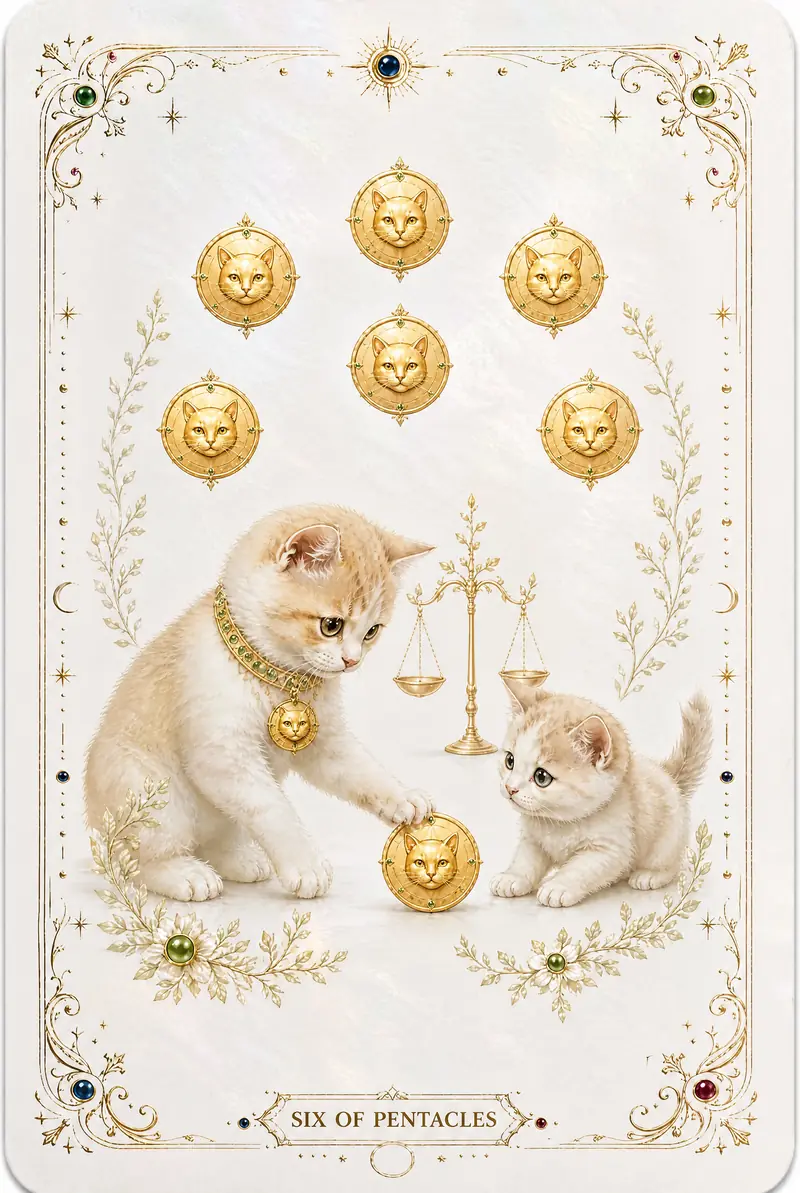
Scales in one hand, alms in the other: giving carries the weight of power too.
The image
A well-dressed merchant stands between two kneeling beggars, handing out coins with one hand and holding a pair of scales in the other. The scales suggest this charity is not casual generosity. It has been measured, and the standing man decides who gets how much.
Core meaning
- Six is the stage of harmony that answers the crisis of Five (see Numbers in Tarot). In Pentacles, resources start to move again: sharing, charity and help that actually arrives. The help that was not taken up in the Five of Pentacles is finally delivered in this card.
- The scales are the real key to this card. Giving and receiving are never purely equal. The standing man holds the measure and the power, and the kneeling men are in the position of being assessed and given to. The Six of Pentacles is about generosity and also about the power relationship hidden inside giving.
- This kind of relationship is often unusually stable, because giver and receiver actually suit each other: one side wants control, and the other, to some degree, wants to be controlled. The lower position does not equal weakness, and sometimes it is the weaker party who quietly works to keep the relationship going.
- Rachel Pollack points out that the giver's side should not be overlooked. The balanced scales in his hand suggest that his generosity does not come naturally. It is the result of carefully working out how much he "can afford," and he gives only what he does not need. This also often describes someone who is easy to get along with but keeps their deepest feelings hidden and never shows them.
- Pollack sums up the card's deeper meaning as "giving others what they are able to receive." Most people unconsciously measure how much they can give according to what the other person expects. Consciously giving what the other person really needs and can take in requires a high degree of self-awareness and insight into people.
- When this card appears, first work out where you stand in the picture: as the one able to give, or as the one receiving help. The two positions describe completely different real situations.
- It also often corresponds to specific money flows: loans, sponsorship, paying wages, charitable donations, any situation in which one side transfers resources to another.
- The scales are also a reminder to give in the right measure. Giving too much easily makes the recipient dependent, even willing to stay in the position of being helped and not want to change. Giving too little hurts their pride and looks half-hearted. Neither extreme counts as truly effective help.
- In the picture, one beggar wears a yellow robe (a symbol of reason) and the other a blue robe (a symbol of feeling), and the reasoning one gets the money first. This suggests that real help should be based on a rational judgment of what the other person actually needs, and not be driven by passing sympathy or moral pressure. One-off generosity with no follow-up can leave a painful letdown afterward and turn kindness into a second injury.
- The giver's gesture echoes the blessing gesture of The Hierophant, so this card is more than simple charity or an employment relationship. It also carries a note of spiritual blessing: the giver guides the other person materially, just as the Hierophant guides the faithful spiritually.
- On money, the upright card often points to success. It may come from selling a property or closing a deal, from a reliable new source of income, or from the results of careful money management. In general there should be a dependable source of income, and spending is under control. On health, the upright card may mean spending money on health (such as getting a gym membership), and in a health spread it usually means a stable condition.
- The arrangement of six pentacles fits a mathematical coincidence: 1+2+3=6 and 1×2×3=6. The sequence itself carries a sense of perfection, harmony and balance.
- The merchant's round hat looks like a ring, a sign of his harmonious relationship with heaven, standing for an understanding of heavenly things and a compassionate heart. The structure of this card also mirrors The Hierophant: two small monks stand below the Hierophant, while two beggars kneel beside the merchant. One guides spiritual growth, the other guides material growth.
- The four-dot pattern on the coins matches a mark that stands for "path" in the symbolic language of carpet patterns. This suggests the merchant is giving more than money. He is giving a road that can be followed, so the help is neither simple charity nor a cold employment arrangement.
Reversed
- The two beggars end up higher than the rich merchant in the picture. Reversed, this suggests that resources given out cannot be recovered, such as money lent and never returned, or a favor owed to someone and forgotten. This is the blocked type.
- The merchant's hand now seems to throw money upward. Reversed, this is more easily read as showy spending: on the surface it is giving, but in fact the giving is used to display one's wealth and status.
- The scales fall from his hand, a sign that this giving or exchange was not carefully weighed and can easily tip clearly to one side.
- From the angle of the negative-meaning method: it is easy to hold unrealistic expectations about the present situation and fall into a trap by taking imagination for fact. Financially, spending without limits leads over time to spending more than one earns, and it is also easy to feel envy and jealousy at what others have.
- From the angle of the opposite-meaning method: this time it is one's own turn to be in the weaker position and need help from others. Accepting help is nothing to be ashamed of, but find a way to get back on your feet as soon as possible. It may also be that one has focused too much on one's own gains and losses and ignored the other person's situation and feelings. To bring things to a good end, set aside fixed opinions first.
- From a money and health angle: the reversal often points to leaving a job, selling a house or car, or going through a period of financial tightening, with less control over income and finances than usual. Sometimes new burdens are taken on before old debts are cleared. On the health side, poor health may be limiting the ability to earn, or illness may keep someone from working for a while. It may also simply be a prompt to look at how work is affecting health. In some cases, the reversed Six of Pentacles means there is not enough money right now to choose the lifestyle one would like.
Correspondences
The number is six (harmony; see Numbers in Tarot). The element is Earth. The astrological correspondence is the second decan of Taurus, with the Moon as the traditional ruler uncertain; see Astrological Correspondences. In the Golden Dawn system this card's esoteric title is "Lord of Material Success"; see Esoteric Titles.