Knight of Cups
Number Kn · Element Water · Correspondence —
Upright: active pursuit, a romantic proposal, idealism, expressing feelings through action
Reversed: empty promises, fickle affections, wanting to pursue but not daring to act
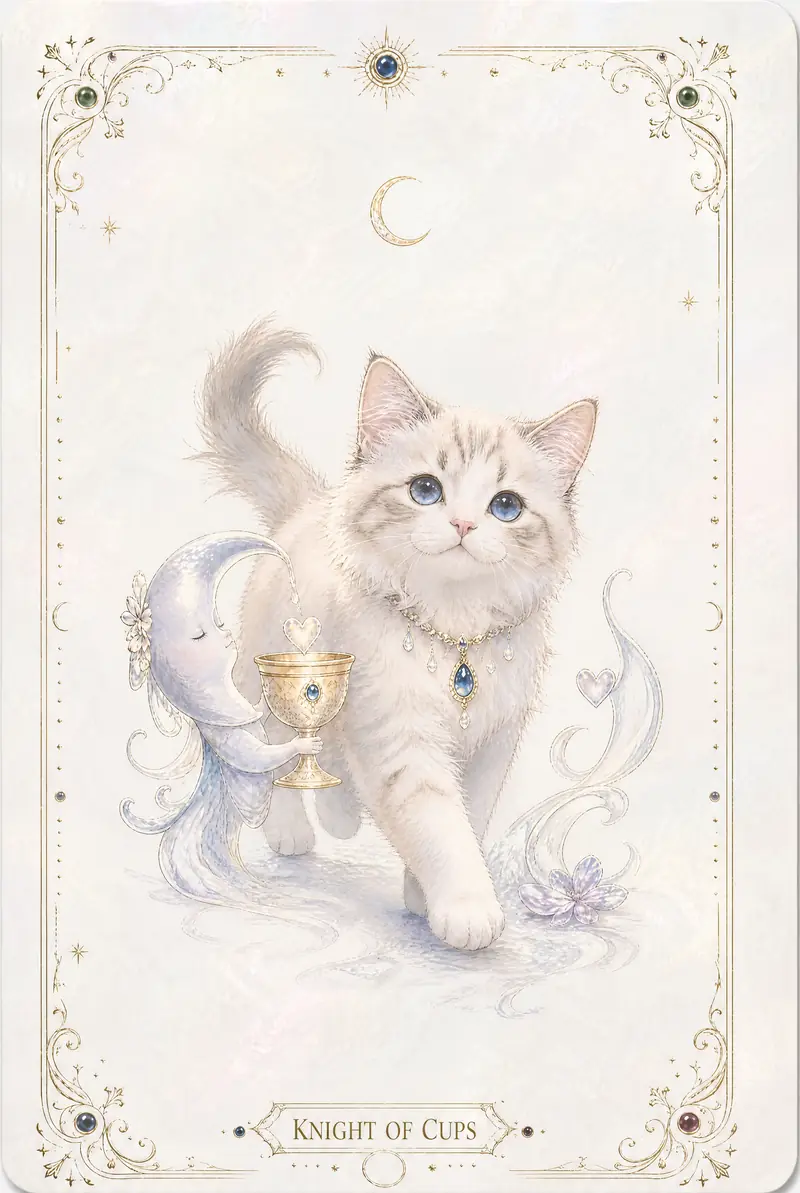
He does not gallop. He holds out his cup at an unhurried pace, as if offering an invitation.
The image
A knight in a winged helmet rides a white horse at a slow walk (unlike the charging knights of the other suits). He holds out a cup in one hand, and a river flows beside him. His bearing is more like someone presenting a gift than someone going into battle.
Core meaning
The Knight's element is Air and the suit's element is Water. Wind ruffles the surface of water into ripples, so this combination is less stable than the Page's Earth and Water, and it has more forward drive [inferred: the elemental dignities do not list the Air and Water pairing directly, so this is reasoned by analogy from the nature of the two elements].
- The Knight's own character is focused on a goal and charges at it full speed. In the Cups, the target of that charge becomes feelings and ideals. This is tarot's archetype of the romantic suitor: declaring love, making a proposal, pursuing a person, a cause or a belief with idealism.
- Air sets Water moving. At the Page stage, intuition has only just surfaced; with the Knight, feeling gains a clear direction and the power to act. This is the first time a Cups court card takes the initiative. Because it is Air with Water, though, the passion ripples easily and is unstable, and a new attraction may turn it toward the next target.
- disputed Pollack reads this Knight more cautiously. In her view, the slow-walking horse and the knight's absorption in the lure of the cup (a symbol of imagination), without acting on it, show that he has not yet learned to bring imagination into the real world. Only a thin stream runs through dry land; his creative drive is the weakest of the Cups court cards, and nothing flows out of his cup (compare the fish that pokes its head out for the Page of Cups). She takes this as a reminder that true imagination has to be fed by action; otherwise it remains vague fantasy cut off from the rest of life.
- Pollack uses the English poet Coleridge's distinction between imagination and fancy to explain the shadow side of this absorption. Both take the mind away from everyday experience, but imagination comes from the unconscious and leads to awareness of hidden spiritual truths, while fancy comes from the ego and produces only passing fantasies that have no real meaning beyond a moment's excitement.
- Pollack also notes that the knight has wings on both his helmet and his boots, and that his appearance resembles Death from the Major Arcana, a symbol of transformation. If this knight is not held back by duty or desire, and follows a sincere vision instead of avoiding commitments to the outside world, his absorption can turn into a deep exploration of the inner world.
- As a person, the card represents someone emotionally rich and charming, good at expressing love, but possibly fickle. As an aspect, it tells the querent it is time to take the initiative: to pursue, to confess, to make the proposal.
- On a spiritual level, the card draws a clear line between two ways of responding to good and bad times. In the negative state, any setback sends the person quickly into a new relationship as a shelter, avoiding a real reckoning with the loss. A Knight of Cups who truly matures instead looks for the spiritual meaning of the setback, learns from it and keeps moving in his own direction, without grabbing a new partner on the spot to fill the emptiness.
Reversed
- Blocked: the distant mountains rise above the knight himself. The ideal is blocked by practical difficulties in the outside world, and he will not do the down-to-earth work to overcome them, so the romantic vision never arrives. The slipping helmet symbolizes lost ideals; he may turn to tricks and schemes to get what he wants.
- Overdone: the river changes course, a hint of emotional promiscuity. He is just as attentive and flirtatious toward people he does not particularly care about, so the warmth goes to the wrong places and no one can tell what he really feels.
- All smooth talk, saying more than doing, so when real ability is needed he is easily exposed. A situation that looks good does not stand up to a closer look and may even be a scam or trap from start to finish.
- Turned inward: an overly idealized dream is lived out only in the head and never actually acted on. Sometimes it also points to a secret romance that cannot be made public.
- This is not the time to trust other people's advice when making major decisions. Assess things practically and do not be too optimistic.
Correspondences
The Knight corresponds to Air, layered on the Water of the Cups; for the logic of the double elements, see The Court Cards. Court cards take no part in the decan correspondences; see Astrological Correspondences.
Views from different traditions
In Crowley's Thoth system, this rank is called the Prince rather than the Knight, and it does not map exactly onto the rank the Waite system calls the Knight. This site uses the Waite names throughout; see The Court Cards. Pollack's view of this Knight is clearly more reserved: she holds that he has not yet turned imagination into action. This contrasts with the common view in many modern tarot books, which simply read the Knight of Cups as a romantic messenger who actively pursues.