King of Pentacles
Number K · Element Earth · Correspondence —
Upright: authority in business, steady control, the strength of the self-made, long-term building power
Reversed: greed and stubbornness, rigid decisions, missing chances through excess caution
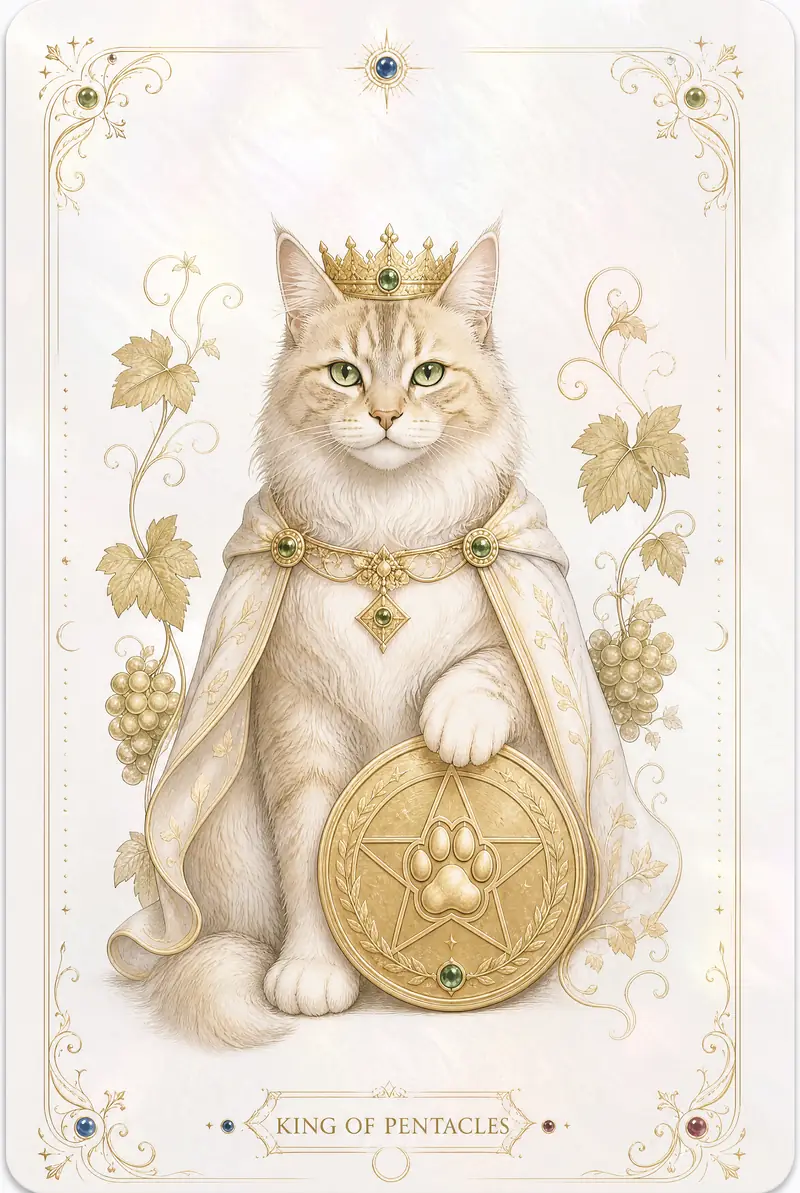
The fire of authority settles into earth. What it produces is a business built up brick by brick, with no blaze of flame.
The image
The King sits on a throne carved with grapevines and bulls' heads, a corner of armor just showing beneath his rich robe. He holds a scepter in one hand and a pentacle in the other, with his castle and lands behind him. His bearing is steady and gives nothing away.
Core meaning
- According to The Court Cards, the King corresponds to Fire (leading, outgoing, using the suit's energy with authority), combined here with the Earth of Pentacles. This combination is not among the standard pairs in elemental dignities (the friendly pairs are Fire with Air and Water with Earth; the hostile ones are Fire with Water and Air with Earth). Fire and Earth have no fixed verdict, a neutral pairing that neither school discusses directly uncertain.
- One way to understand it: the outgoing, assertive authority a king should have is absorbed and digested by Earth's steadiness, and turns into a kind of leadership that relies on results and no show of force. Of the four kings, he is the least fond of empty talk and the most focused on real control and long-term building inferred.
- Rachel Pollack's reading of this card stresses closeness to nature. The castle, a symbol of social status, is pushed into the background, while he himself sits comfortably in a garden. The grapes stand for the sweetness of life, flowers rest on his crown, and the vines seem to blend into his robe. The King of Pentacles' success includes more than the wealth and status he has built up; it also includes the ability to relax and enjoy life itself.
- Pollack notes that this ease was not always there. When young, this king may have suffered setbacks from impatience or self-doubt. His achievements now finally let him relax, so he no longer has to be weighed down by the duties of the king's role the way the King of Wands and the King of Cups are.
- Pollack offers an intriguing contrast. The King of Pentacles is the card that closes the Minor Arcana, and The Fool opens the Major Arcana, so the two seem to sit at opposite ends of the tarot sequence: one stands for worldly achievement and status, the other for an inner freedom not bound by material things. But if the whole deck is imagined as a circle instead of a line, The Fool and the King meet end to end. True abundance means having the King's achievements while keeping the Fool's freedom from being trapped by them.
- Compared with the Knight of Pentacles (Air and Earth in conflict, a caution that cannot move), the King's Earth does not hold back Fire. It refines Fire's drive into a lasting power to build. Moving from the double-Earth Page through the hostile pairing of the Knight and the friendly pairing of the Queen to the King, this is the most mature of the suit's court cards, the first place where authority and steadiness are truly in step inferred.
- It often stands for an authority figure who is very successful in material terms and willing to take responsibility for looking after a team or family. It can also be the side of the querent that needs to show real control.
- On money and health: he is practical and hardworking, and rewards his efforts with a few practical possessions (a good car or a good watch, for example). He knows that a worthwhile life needs a solid financial base. Working steadily toward a stable goal, he is often rewarded with financial security. Under pressure, he tends to regain a sense of control by working even harder. After repeated setbacks he may quietly save money and plan his exit, and sometimes he uses money to control the people around him, such as cutting off support to his children until they agree to do things his way.
Reversed
- Overdone: the castle walls flip to the top of the picture, and the defensive stance is pushed to an extreme, easily becoming headstrong and stubborn. The King now looks toward the side of domination and control, and he may exploit others for his own gain, even using improper means to take what does not belong to him.
- Blocked: the scepter slips from his hand, a sign of losing his former control and power. He appears weak, timid and not up to the task, in contrast to the steadiness of the upright card.
- Spending too much to show off wealth or keep up appearances brings real financial problems on himself, or he may swing into being a miser who will not part with a penny.
- Turned inward: the problem itself has a structural flaw, and patching parts of it no longer helps. A full review is needed, or even tearing it down and starting over. It may also be a financial crisis that is hard to reverse.
- On this matter, he has completely lost the common-sense judgment he should have and can easily make foolish decisions. This is when he most needs to listen humbly to others' advice.
- From a money and health angle: the reversal may show material greed, treating employees harshly while spending lavishly on himself. He craves money but lacks the inner stability to keep it, so his finances swing between generosity and gloom. The root is often that his work is not what he truly wants, so he keeps trying to fill an inner emptiness with material things.
Correspondences
The rank is King, and the element is Fire (the King's rank element) combined with Earth (the Pentacles suit element). For the relationship between the two, see elemental dignities (not one of the standard friendly or hostile pairs) and The Court Cards.