King of Cups
Number K · Element Water · Correspondence —
Upright: emotional maturity, calm outside and rich inside, good at listening and mediating, restraint
Reversed: emotional distance and coldness, manipulating others through emotion (two opposite directions `[disputed]`)
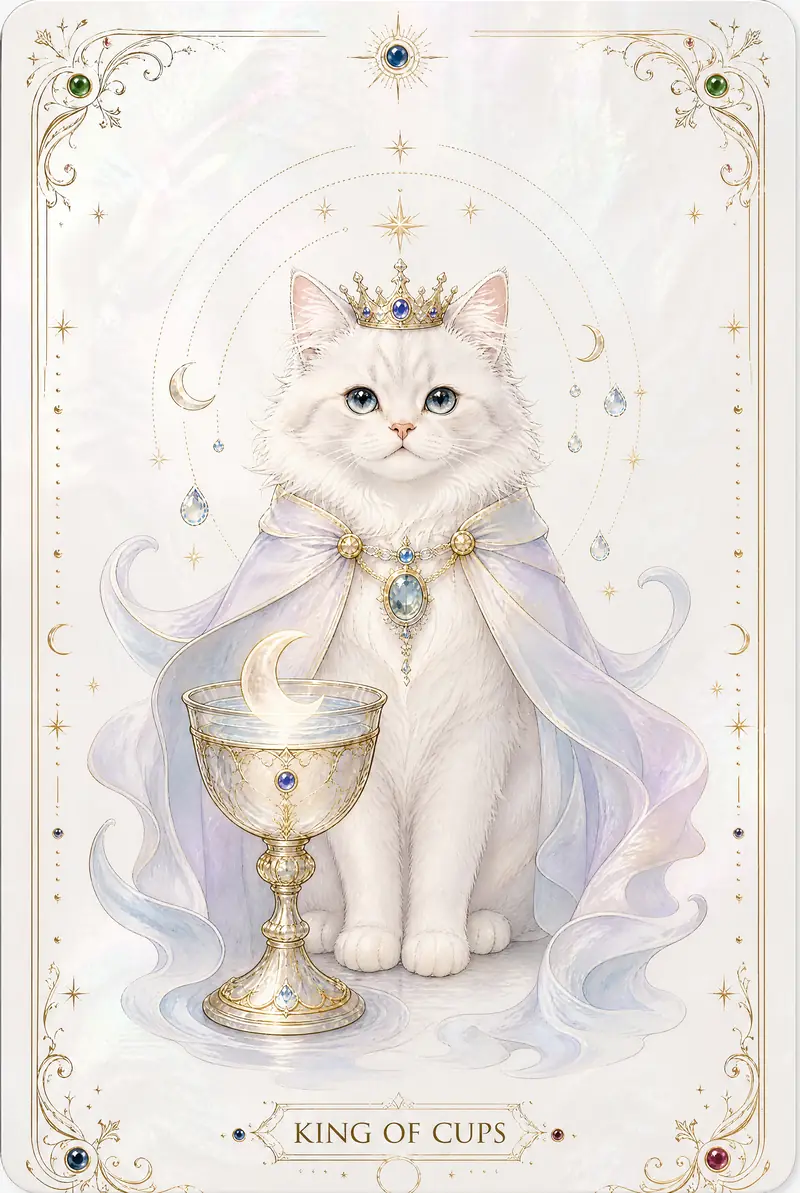
His throne stands on the waves, yet he sits perfectly steady, a cup in one hand and a scepter in the other.
The image
The King sits upright on a stone throne that almost floats on a rough sea. The water churns at his feet, and in the distance a ship tosses on the waves and a fish leaps out of the water. His own expression is calm and restrained. He holds up a cup in one hand and grips a scepter in the other, and a fish-shaped pendant hangs on his chest.
Core meaning
The King's element is Fire and the suit's element is Water, and Fire and Water oppose each other (see Elemental Dignities). This is where the card's central tension lies. He does have feelings. He uses will and structure to press those surging feelings down into a calm surface, just as the churning sea under his throne contrasts with the King's steady posture [inferred; see <a class="acad-link" href="/academy/court-cards">The Court Cards</a> on the King's Fire paired with the Water of the Cups].
- This is the peak of maturity among the Cups court cards. The Page first touches feeling, the Knight actively pursues it, the Queen understands it inwardly, and with the King feeling is truly managed and becomes a resource he can offer to others. He can listen to people pour their hearts out without getting swept up, and he can stay composed in chaos. He is a natural mediator, adviser and mentor.
- As a person, he represents someone with high emotional intelligence, gentle and restrained on the outside, who feels a great deal inside but rarely shows it. Often this is the older relative or friend who will listen to anything you have to say but seldom complains about their own troubles.
- The fish pendant on his neck is a symbol of creativity, but it is a man-made ornament. The truly living creativity is the fish leaping in the waves behind the throne, which he has pushed into the background. His throne floats on the rough sea, yet he never touches the water himself (compare the Queen of Cups, who holds her cup and gazes into it). This contrast shows that his achievements still come from creative imagination, but the way he has shaped his life has cut him off from his own joyful, poetic imagination.
- At an extreme, this restraint becomes building a dam and locking his feelings and imagination away completely. In a milder form, he expresses these qualities but does not let them become the center of his life. For him, responsibility always comes before self-expression.
- Pollack also points out a detail: he does not look at the cup in his hand, and he holds it the way he holds the scepter, a symbol of power. Some commentators conclude from this that the King is not emotionally calm at all and may even be hiding anger or violence, habitually suppressing it and keeping up a calm front even to himself.
- In career questions, the King of Cups is better suited to work connected with creative or spiritual meaning than to a high-intensity competitive environment, and he tends to deliberately avoid direct competition. This description can help judge whether a job or career direction really suits the person in question.
- In health questions, watch for how this card copes when it turns negative. He habitually hides intense emotional upheaval, and at an extreme he may numb himself with alcohol or drugs instead of dealing with the emotions directly. In a reading where a health issue involves the King of Cups, check whether the querent is using substances to avoid emotional problems that need facing. Healthy ways out of a low period include a trip to the seaside, calming music and heart-to-heart talks with friends, using creative action to recover emotional balance and trust in others.
Reversed
- Blocked: the ship and the fish rise above the King himself. Outside risks and conflicts are magnified, and the situation may already be beyond what he can handle.
- Overdone: ambition to expand and control everything, without real ability to carry it out, ends up as empty fantasy. The sea flooding over the throne suggests an unusually strong need for emotional connection; he often feels unsatisfied and longs for more.
- The risk of saying one thing and being another is especially high. Do not be fooled by an outward show of ease and authority; the real situation may already be precarious.
- Turned inward: people in the environment do not trust one another and complaints simmer under the surface. Even if relationships are kept up on the surface, cooperation is hard to move forward.
- disputed It may also show up as one of two extremes: preaching morality in public while being hypocritical and selfish in private, or being full of fear inside and feeling unable to cope with outside challenges and emotions.
Correspondences
The King corresponds to Fire, layered on the Water of the Cups; for the logic of the double elements, see The Court Cards. Court cards take no part in the decan correspondences; see Astrological Correspondences.
Views from different traditions
In Crowley's Thoth system, this rank is called the Knight rather than the King, which is easily confused with the different rank the Waite system calls the Knight. This site uses the Waite names throughout; see The Court Cards. Pollack adds that because he leads the whole suit of Cups, in contexts involving artistic work the card can also simply stand for great skill and outstanding achievement.